The Treasure Trove Beneath Our Feet
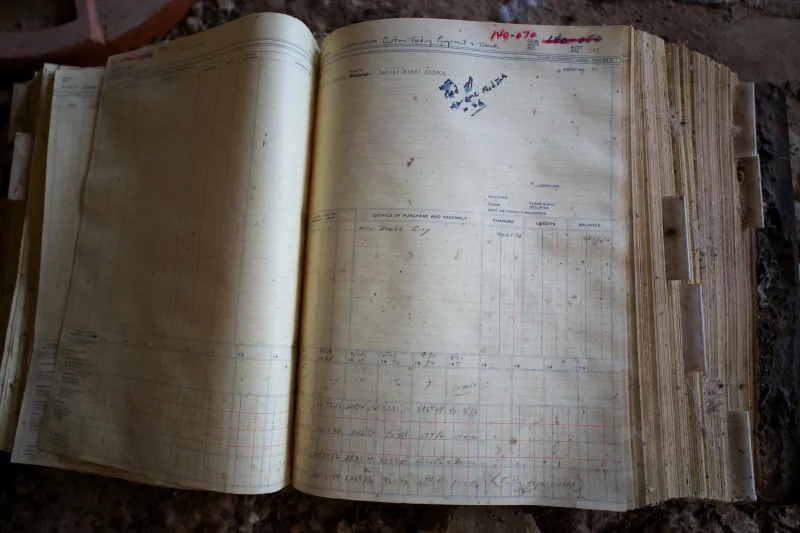
Beneath the modest brick buildings of the Met Office archive in Exeter lies one of humanity's most comprehensive records of atmospheric behaviour. Here, alongside thousands of similar repositories across Britain, rest centuries of meticulous weather observations: handwritten logbooks from Victorian lighthouse keepers, punch cards from early computer systems, and miles of barograph paper traces that chronicle every atmospheric tremor since the 1850s.
 Photo: Met Office, via en.econostrum.info
Yet this irreplaceable scientific heritage faces an enemy more relentless than any storm: time itself. Paper yellows and crumbles, ink fades, magnetic tape degrades, and the analogue formats that once seemed permanent now teeter on the edge of obsolescence. Without immediate action, Britain risks losing the very foundation upon which modern climate science was built.
The Scale of the Challenge
Britain's meteorological records represent the longest continuous weather observation programme in the world, with some station records extending back to the 1660s. The Central England Temperature series, maintained since 1659, stands as the world's longest instrumental temperature record. These archives contain not merely historical curiosities, but data points crucial to understanding natural climate variability and distinguishing human influence from natural fluctuation.
The preservation challenge is staggering in scope. The Met Office alone holds approximately 30 million weather observations in non-digital formats, whilst regional archives, university collections, and private holdings add millions more. Each document requires careful handling, specialist scanning equipment, and sophisticated optical character recognition software to extract meaningful data.
Dr Sarah Mitchell, head of the Met Office's Historical Weather Data Recovery project, describes the urgency: "We're essentially racing against entropy. Every month of delay means more documents become too fragile to handle, more magnetic tapes lose their coherence, and more knowledge disappears forever."
Volunteer Army on the Front Lines
The scale of digitisation required has prompted an unprecedented collaboration between professional archivists and volunteer scientists. The Weather Rescue project, launched in 2017, has mobilised thousands of citizen scientists to transcribe historical weather records from their homes. Using specially designed web interfaces, volunteers can examine scanned documents and input data directly into research databases.
This crowdsourced approach has proven remarkably effective. Volunteers have already rescued over 6 million weather observations, extending useable climate records for dozens of locations by decades. The project particularly targets periods of significant climatic interest, such as the harsh winters of the 1880s and the drought conditions of the 1970s.
Retired meteorologist James Hartwell, who has transcribed over 50,000 observations, explains the appeal: "Each logbook entry represents someone standing outside, regardless of conditions, to record what they observed. There's a human story behind every number, and knowing that this data might help future generations understand climate change makes the work deeply meaningful."
Technical Hurdles and Breakthrough Solutions
Digitising historical weather records presents unique technical challenges that push the boundaries of current technology. Victorian handwriting varies dramatically between observers, abbreviations change over time, and damage from water, insects, or simple age can render crucial figures illegible.
Optical character recognition software, whilst sophisticated, struggles with the inconsistencies of historical documents. Research teams at the University of Reading have developed machine learning algorithms specifically trained on meteorological handwriting, achieving recognition rates of over 85% for clearly written documents. However, damaged or poorly preserved records still require human interpretation.
 Photo: University of Reading, via blogs.reading.ac.uk
The challenge extends beyond simple data capture. Historical instruments measured different parameters using varying scales and calibration methods. Modern digitisation efforts must account for these differences, applying correction factors and uncertainty estimates to ensure historical data remains scientifically useful.
Climate Science Stakes
The scientific importance of rescuing these records extends far beyond historical interest. Climate models rely heavily on long-term observational data to validate their projections and understand natural variability. Extended historical records can reveal patterns invisible in shorter datasets, such as multi-decadal oscillations in temperature and precipitation.
Recent digitisation successes have already yielded significant scientific insights. Newly recovered 19th-century pressure readings have helped researchers better understand the behaviour of the North Atlantic Oscillation, a climate pattern that strongly influences European weather. Similarly, extended temperature records have refined estimates of natural climate variability, improving the precision of climate change attribution studies.
Professor Catherine Reynolds of Cambridge University's Climate Research Centre emphasises the broader implications: "These historical records provide the baseline against which we measure current climate change. Without them, we lose crucial context for understanding whether current changes are unprecedented or part of longer-term natural cycles."
Institutional Coordination and Future Sustainability
Recognising the national importance of weather data preservation, the Natural Environment Research Council has established the UK Weather Data Recovery Initiative, coordinating efforts across multiple institutions. This programme prioritises the most vulnerable and scientifically valuable records whilst developing standardised digitisation protocols.
The initiative faces significant funding challenges, however. Comprehensive digitisation of Britain's meteorological heritage would require an estimated £15 million over five years, a substantial investment that competing research priorities often overshadow. Current funding supports only the most critical preservation efforts, leaving vast archives vulnerable to continued deterioration.
Racing Against Time
As climate change accelerates and extreme weather events become more frequent, the value of historical perspective grows ever greater. Britain's meteorological archives represent an irreplaceable scientific resource that could illuminate patterns crucial to future climate adaptation strategies.
The preservation window is closing rapidly. Documents stored in suboptimal conditions may have only years before becoming too fragile to handle safely. Magnetic media from the 1960s and 1970s approaches the limits of its useful life, whilst early computer formats require increasingly specialised equipment to access.
The race to save Britain's weather records reflects a broader challenge facing scientific archives worldwide. In an age of rapid technological change, ensuring the long-term accessibility of scientific knowledge requires constant vigilance and substantial resources. For Britain's meteorological heritage, the clock is ticking, and every rescued observation brings us closer to understanding our climate's past and future.