The Foundation of Trust
In a nondescript industrial estate in Teddington, Dr Sarah Matthews adjusts a laser interferometer with the precision of a master craftsman. As a senior metrologist at the National Physical Laboratory (NPL), she is part of Britain's most fundamental scientific infrastructure—one that most researchers never see but entirely depend upon.
"Every measurement made in British science ultimately traces back to us," Matthews explains, gesturing toward the temperature-controlled chamber housing primary standards. "When a pharmaceutical company claims their tablet contains exactly 500mg of active ingredient, or when climate scientists measure atmospheric CO2 to three decimal places, that accuracy depends on an unbroken chain of calibrations leading back to these rooms."
This chain of traceability, established through Britain's network of accredited calibration laboratories, represents one of the country's most critical yet invisible scientific assets. The United Kingdom Accreditation Service (UKAS) oversees approximately 800 calibration laboratories across the nation, each serving as a vital link between the NPL's primary standards and the instruments that drive British research and industry.
The Metrological Ecosystem
The calibration laboratory network operates on a hierarchical principle that would be familiar to any medieval guild system. At the apex sits the NPL, custodian of Britain's primary measurement standards and one of the world's oldest national measurement institutes. Below this, secondary laboratories maintain reference standards calibrated directly against NPL's primaries. Working laboratories then calibrate the everyday instruments used in research facilities, hospitals, and manufacturing plants across the country.
This system touches virtually every aspect of British scientific endeavour. Professor James Henderson, who manages the analytical chemistry facility at the University of Edinburgh, describes the relationship as "invisible but absolutely essential."
 Photo: University of Edinburgh, via c8.alamy.com
"We send our balances, thermometers, and pH meters for calibration every year," Henderson notes. "Without that certificate, our data would be scientifically worthless. Grant bodies, regulatory agencies, and peer reviewers all expect to see that unbroken chain of traceability."
The pharmaceutical sector provides perhaps the most striking example of this dependency. GlaxoSmithKline's manufacturing facility in Ware processes billions of tablets annually, each requiring precise dosing verified through calibrated analytical balances. A single uncalibrated instrument could compromise entire production batches worth millions of pounds.
Human Stories Behind the Standards
Behind this technical infrastructure lies a community of specialists whose expertise spans generations. At Campden BRI, Britain's food research association, chief metrologist Dr Michael Thompson has spent four decades ensuring that food safety measurements meet international standards.
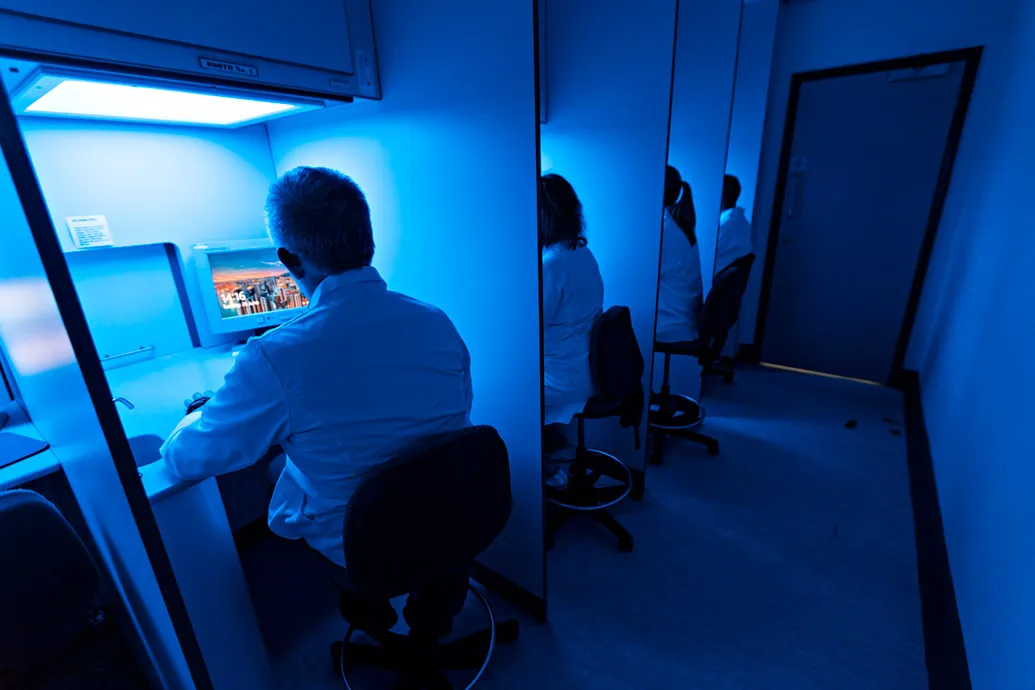 Photo: Campden BRI, via www.dextragroup.co.uk
"People think calibration is just about machines," Thompson reflects, "but it's really about trust between people. When I certify that a temperature probe is accurate to 0.1°C, laboratories across Europe accept that statement based on relationships built over decades."
This human dimension becomes particularly apparent in specialised fields. Marine biologist Dr Emma Richardson recalls the panic when her research vessel's CTD sensor—critical for measuring ocean conductivity, temperature, and depth—failed calibration just before a major Antarctic expedition.
"We had 48 hours to find a laboratory capable of calibrating oceanographic equipment," Richardson remembers. "It took calls to five different facilities before we found one with the right expertise. That delay nearly cost us the entire research season."
Pressure Points and Vulnerabilities
Despite its critical importance, Britain's calibration infrastructure faces mounting pressures that threaten its long-term sustainability. Budget constraints across the university sector have led some institutions to extend calibration intervals or seek cheaper alternatives, potentially compromising measurement quality.
The NPL itself has not been immune to these pressures. Government funding reductions have forced the laboratory to increasingly rely on commercial revenue, raising questions about its ability to maintain comprehensive primary standards across all measurement disciplines.
Dr Alan Stevens, who spent thirty years at the NPL before establishing an independent calibration laboratory, warns of a "hollowing out" of expertise. "The older generation of metrologists is retiring, but universities aren't training replacements. We're creating knowledge gaps in specialised areas that could take decades to rebuild."
Brexit has added another layer of complexity. While Britain maintains its measurement sovereignty through the NPL, the loss of automatic recognition agreements with EU calibration bodies has created bureaucratic barriers for British laboratories serving international clients.
The Innovation Imperative
Yet within these challenges lie opportunities for renewal. Emerging technologies such as quantum sensors and artificial intelligence are revolutionising measurement science, offering the potential for more accurate and efficient calibration processes.
The NPL's quantum technology programme, for instance, is developing atomic clocks and quantum voltage standards that could redefine measurement accuracy. These advances promise to maintain Britain's position at the forefront of measurement science while potentially reducing costs through improved efficiency.
Digital calibration certificates, implemented during the COVID-19 pandemic, have demonstrated how technology can streamline traditional processes while maintaining security and traceability. The system has proven so successful that many laboratories are making the digital transition permanent.
Securing the Foundation
As British science faces increasing international competition, the calibration laboratory network represents both a strategic asset and a potential vulnerability. Countries like China and South Korea are investing heavily in their national measurement infrastructure, recognising its importance for technological sovereignty.
"Measurement capability is like any other infrastructure," argues Professor Henderson. "You don't appreciate it until it fails. But unlike a broken road, a broken calibration chain undermines the credibility of everything built upon it."
The challenge for British policymakers is ensuring that this invisible infrastructure receives the attention and investment it requires. As Dr Matthews at the NPL puts it: "We're the guardians of truth in measurement. That responsibility doesn't come with fanfare, but it's fundamental to everything else British science achieves."
In an era where scientific credibility faces unprecedented scrutiny, Britain's calibration laboratories remain the quiet custodians of empirical honesty—a role that, while invisible to most, proves indispensable to all.